
Removing Elements of a Vector: Rebuild or use vector<>::erase()?

When it comes time to remove elements from a vector<>, you have two choices:
rebuild the
vector<>and omit certain valuesuse
vector<>::erase()to remove elements
The challenge is that the two can have significantly different performance times. Here, we look at two situations. For the first, we will manage a vector<int> and time the removal of a set of values using both the rebuilding approach and the vector<>::erase() operation. In the second, we create a larger data structure and do the same thing. As we will see, when using ints we get one result and another when dealing with the larger structure. The point is, you have to consider your application when choosing.
All the Code
The examples below can all be integrated in a single file. If you are curious about the headers involved, they are
#include <algorithm>
#include <chrono>
#include <iostream>
#include <vector>
Managing a Vector of ints
In this case, we start with a vector<> of ints. The list will consist of 0’s and 1’s. A zero will indicate an item should be removed from the collection when we compare techniques. This function will generate a list of length numberOfElements and randomly flag numberOfZeroes elements to be removed.
vector<int> getIntList(int numberOfElements, int numberOfZeros) {

    vector<int> result;

    vector<int> zeroes;

    vector<int>::iterator it;

    int newZero;


    for (int z=0; z < numberOfZeros; ++z) {

        do {

            newZero = rand() % numberOfElements;

        } while(find(zeroes.begin(), zeroes.end(), newZero)
                                                  != zeroes.end());

        zeroes.push_back(newZero);

    }


    for (int e=0; e < numberOfElements; ++e) {

        if (find(zeroes.begin(), zeroes.end(), e)
                                        == zeroes.end()) {

            result.push_back(1);

        } else {

            result.push_back(0);

        }

    }

    return result;

}
We generate one list and make copies for each of the approaches to work with. We will time two separate functions. The first is doIntRebuild(), where we create a new vector<> by populating it with the unflagged elements (non-zeros).
vector<int> doIntRebuild(const vector<int> &list) {

    vector<int> result;

    for (auto x : list) {

        if (x != 0) {

            result.push_back(x);

        }

    }

    return result;

}
The second function, doIntErase(), we use vector<>::erase() to remove the elements from the source list.
void doIntErase(vector &list) {

    auto it = list.begin();

    while (it != list.end()) {

        if (*it == 0)  {

            list.erase(it);

        } else {

            ++it;

        }

    }

}
Lastly, we create a main() that times the two functions.
int main() {

    const int SIZE = 10000;
    const int REMOVE_COUNT = 1000;

    srand(time(0));

    vector intList = getIntList(SIZE, REMOVE_COUNT);

    vector rebuildIntList(intList);
    vector eraseIntList(intList);

    chrono::steady_clock::time_point start;
    chrono::steady_clock::time_point stop;

    chrono::duration elapsed;
    chrono::microseconds elapsedUSec;


    // INT LIST : REBUILD
    //
    cout << “INT LIST” << endl;

    start = chrono::high_resolution_clock::now();

    rebuildIntList = doIntRebuild(rebuildIntList);

    stop = chrono::high_resolution_clock::now();

    elapsed = stop - start;

    elapsedUSec = chrono::duration_cast(elapsed);

    cout << “Time to rebuild: “
         << elapsedUSec.count()
         << “ microseconds.”
         << endl;


    // INT LIST : ERASE
    //
    start = chrono::high_resolution_clock::now();

    doIntErase(eraseIntList);

    stop = chrono::high_resolution_clock::now();

    elapsed = stop - start;

    elapsedUSec = chrono::duration_cast(elapsed);

    cout << “Time to erase  : “
         << elapsedUSec.count()
         << “ microseconds.”
         << endl;

    return 0;

}
Running this program on a Mac with an Intel 3.8 GHz i7 processor, and varying the number of elements in the lists as well as the number of elements that should be removed, we get the following results:
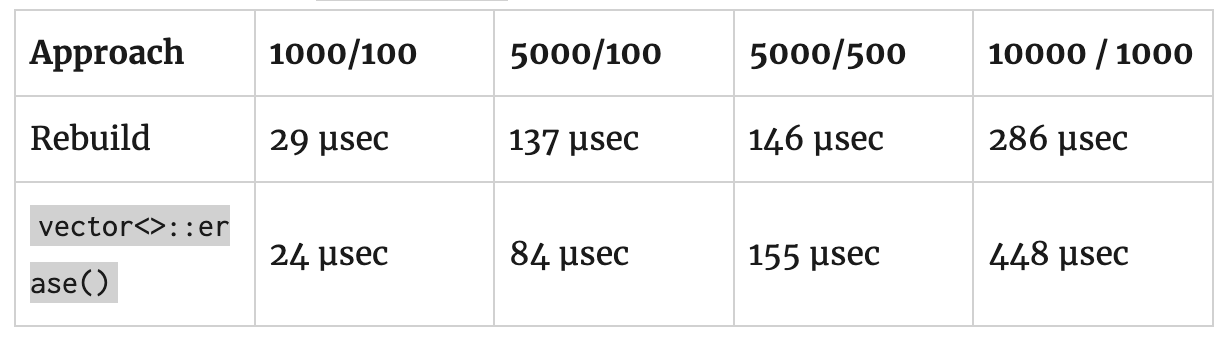
We see that in some cases vector<>::erase() is more efficient, but as the list size and number of elements to be removed grows, rebuilding seems to be the better choice.
Managing a Vector of Large Objects
We now do the same thing with a larger type:
struct BigBoy {
    int data[100];
};
That is, we generate a list of BigBoy objects where some have the first element in the underlying array, data, set to 0 to indicate they should be removed and others with a 1.
vector<BigBoy> getBigBoyList(int numberOfElements, int numberOfZeros) {

    vector<BigBoy> result;

    vector<int> zeroes;

    vector<int>::iterator it;

    int newZero;

    BigBoy bigBoy;


    for (int z=0; z < numberOfZeros; ++z) {

        do {

            newZero = rand() % numberOfElements;

        } while(find(zeroes.begin(), zeroes.end(), newZero)
                                                  != zeroes.end());

        zeroes.push_back(newZero);

    }

    for (int e=0; e < numberOfElements; ++e) {

        if (find(zeroes.begin(), zeroes.end(), e)
                                          == zeroes.end()) {

            bigBoy.data[0] = 1;

        } else {

            bigBoy.data[0] = 0;

        }

        result.push_back(bigBoy);

    }

    return result;

}
We also create two functions, doBigBoyRebuild() and doBigBoyErase(), which are analgous to what we did with the int vectors.
vector<BigBoy> doBigBoyRebuild(const vector<BigBoy> &data) {

    vector<BigBoy> result;

    for (auto bigBoy : data) {

        if (bigBoy.data[0] != 0) {

            result.push_back(bigBoy);

        }

    }

    return result;

}


void doBigBoyErase(vector<BigBoy> &data) {

    auto it = data.begin();

    while (it != data.end()) {

        if (it->data[0] == 0)  {

            data.erase(it);

        } else {

            ++it;

        }

    }

}
We updated the main() to use these functions and ran the same tests. Here are the results:
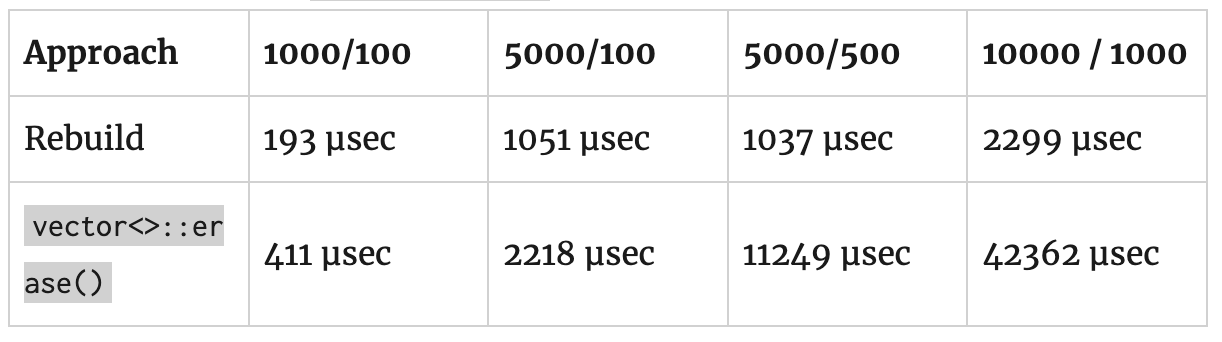
Clearly, there is a need to consider how to manage removal of items from a container.